Committee for the Awareness of Low-Level Psychiatric Symptoms
Updated June 27, 2026
Recognizing distress before it becomes crisis.
The Committee for the Awareness of Low-Level Psychiatric Symptoms exists to help people notice mental and emotional distress earlier, speak about it more clearly, and seek help before suffering escalates into emergency. The First Baptist Church of America believes that caring for the soul includes caring for the mind, the body, the family, and the daily life of the person who is struggling quietly.
Many mental health crises do not begin loudly. They begin as sleeplessness, irritability, isolation, dread, numbness, racing thoughts, compulsive habits, persistent sadness, loss of focus, unexplained anger, or the slow collapse of ordinary functioning. These symptoms may seem manageable at first. They may even seem embarrassing, private, or “not bad enough” to mention. But early recognition can change the course of a life.
This committee is not a clinic, a substitute for medical care, or a replacement for licensed mental health professionals. It is a public awareness and preparation effort. Its purpose is to reduce shame, improve communication, encourage timely care, and help people recognize when they may need support.
The problem we are trying to address
America is in a mental health crisis, and much of that crisis is hidden in plain sight. Many people wait until they are overwhelmed before asking for help. Others know something is wrong, but cannot find the words to explain it. Some minimize their symptoms because they are still working, parenting, studying, worshiping, or surviving. They assume that because they are still standing, they must be fine.
But functioning is not the same thing as flourishing.
Low-level symptoms matter because they are often the first signs that something deeper needs attention. A person does not need to be in total collapse before they deserve help. A family does not need to reach catastrophe before a conversation begins. A community does not need to wait for tragedy before it learns how to notice pain.
The first step toward healing is not always a breakthrough. Sometimes it is a sentence: “Something has been wrong lately, and I need help saying what it is.”
What we mean by “low-level psychiatric symptoms”
By “low-level psychiatric symptoms,” we mean early or moderate signs of mental, emotional, or behavioral distress that may interfere with daily life but have not yet become an obvious crisis. These may include changes in sleep, appetite, energy, mood, attention, motivation, relationships, decision-making, or ability to complete normal responsibilities.
Low-level does not mean unimportant. It means early enough to notice. Early enough to name. Early enough, perhaps, to prevent greater harm.
This language is not intended to encourage self-diagnosis. It is intended to help people recognize patterns worth discussing with a qualified professional. The goal is not to label people. The goal is to help them get care.
What this committee does
The Committee for the Awareness of Low-Level Psychiatric Symptoms develops and shares practical tools that help individuals prepare for mental health conversations, recognize patterns in their own lives, and seek professional support with greater clarity.
This includes public education, appointment preparation resources, church and community awareness materials, and practical guidance for people who may not know how to begin. The work is simple on purpose. A person in distress does not need a maze. They need a doorway.
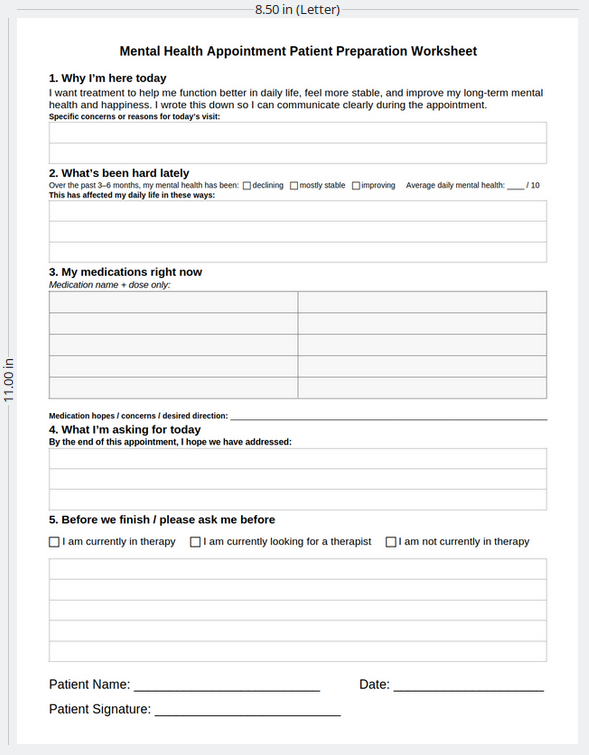
The committee’s first public resource is the Mental Health Appointment Preparation Worksheet, a simple document designed to help people organize their thoughts before speaking with a doctor, therapist, counselor, psychiatrist, psychiatric nurse practitioner, or other licensed mental health provider.
Download the Mental Health Appointment Preparation Worksheet
The Mental Health Appointment Preparation Worksheet helps individuals write down why they are seeking care, what has been difficult recently, how their mental health has changed over the past three to six months, what medications they are taking, what they hope to address during the appointment, and whether they are currently in therapy.
It is available in two formats:
Download Printable PDF - For printing, handwriting, and bringing to an appointment.
Download Editable DOCX - For typing, saving, editing, or adapting before an appointment.
This worksheet can be used privately or shared with a provider. It is especially useful for people who become anxious during appointments, forget details under pressure, struggle to summarize their symptoms, or need help turning scattered thoughts into clear requests.
Why appointment preparation matters
Many people walk into mental health appointments carrying months or years of distress, then find themselves unable to explain what has been happening. They may forget important symptoms. They may downplay their pain. They may leave without asking the question they most needed answered.
Preparation gives the patient a stronger voice.
A written worksheet can help someone say, “Here is what has changed. Here is what I am worried about. Here is how this is affecting my life. Here is what I am asking for today.” That kind of clarity helps providers respond more effectively. It also helps the individual feel less alone inside the appointment.
The church offers this resource because people deserve tools that make care easier to seek. Not colder. Not more bureaucratic. Easier. More human.
What this project is not
This committee does not diagnose mental illness. It does not provide medical advice. It does not prescribe medication. It does not replace therapy, psychiatry, emergency care, or the judgment of licensed professionals.
The First Baptist Church of America recognizes the dignity of professional mental health care. Faith and medicine do not need to be enemies. Prayer, therapy, medication, community, repentance, rest, grief, and disciplined care may all have their place in the healing of a human life.
We reject shame as a treatment plan.
When to seek urgent help
If you are in immediate danger, believe you may harm yourself or someone else, or are experiencing a medical or psychiatric emergency, call 911 or go to the nearest emergency room.
If you are experiencing suicidal thoughts, emotional distress, substance use concerns, or simply need someone to talk to in a crisis, you can call or text 988 or use the 988 Lifeline chat. The 988 Suicide & Crisis Lifeline describes its service as available for people facing mental health struggles, emotional distress, alcohol or drug use concerns, or needing someone to talk to. The Lifeline also states that call, text, and chat support is available, and that using the service is free and confidential.
You are not required to prove that your pain is severe enough before asking for help.
For families, churches, and communities
The people closest to someone in distress often notice changes before that person knows how to name them. A friend may withdraw. A parent may become constantly agitated. A teenager may stop sleeping. A spouse may seem present in body but absent in spirit. A coworker may become uncharacteristically disorganized or hopeless.
The purpose of awareness is not suspicion. It is compassion.
Families and communities should learn to ask better questions, listen without immediate judgment, and encourage professional help when patterns persist. A caring community does not treat mental health symptoms as moral failure. It treats them as signs that a person may need support, evaluation, rest, treatment, protection, or accompaniment.
The church’s moral commitment
The First Baptist Church of America believes that the suffering mind is not disposable, shameful, or outside the concern of God. A person in mental distress is not weak for needing help. They are human. They are beloved. They are worthy of care before the breaking point.
This committee exists because early recognition can preserve families, prevent emergencies, strengthen communities, and help people return to themselves before the crisis becomes all-consuming.
The work begins with awareness. It continues through honesty. It matures into care.
How to participate
You can participate in this project by downloading and sharing the worksheet, using it before an appointment, offering it to someone who may need help preparing for care, or helping the church develop additional practical resources for mental health awareness.
Professionals, pastors, counselors, educators, caregivers, and community members who want to contribute to this work are invited to contact the First Baptist Church of America.

Frequently Asked Questions
-
No. It can be used before meeting with a psychiatrist, therapist, counselor, primary care doctor, psychiatric nurse practitioner, or other licensed provider. It is simply a preparation tool.
-
No. The committee does not provide diagnosis, therapy, medication, or medical treatment. It helps people recognize concerns and prepare to speak with qualified professionals.
-
You do not need to wait until symptoms are severe to ask for help. If something has changed in your mood, behavior, sleep, relationships, focus, or daily functioning, it may be worth discussing with a professional.
-
Yes. The worksheet is designed to be shared. It may be especially helpful for people who feel overwhelmed, anxious about appointments, or unsure how to explain what they are experiencing.
-
Call 911 or go to the nearest emergency room if you are in immediate danger. For suicidal thoughts, emotional distress, substance use crisis, or urgent mental health support, call or text 988 or use the 988 Lifeline chat.
Closing statement from the Committee
A crisis is not the first moment a person deserves care. The First Baptist Church of America is committed to helping people notice distress earlier, speak about it more clearly, and seek help with less shame. The mind is part of the person. The person is worthy of care. Amen.